
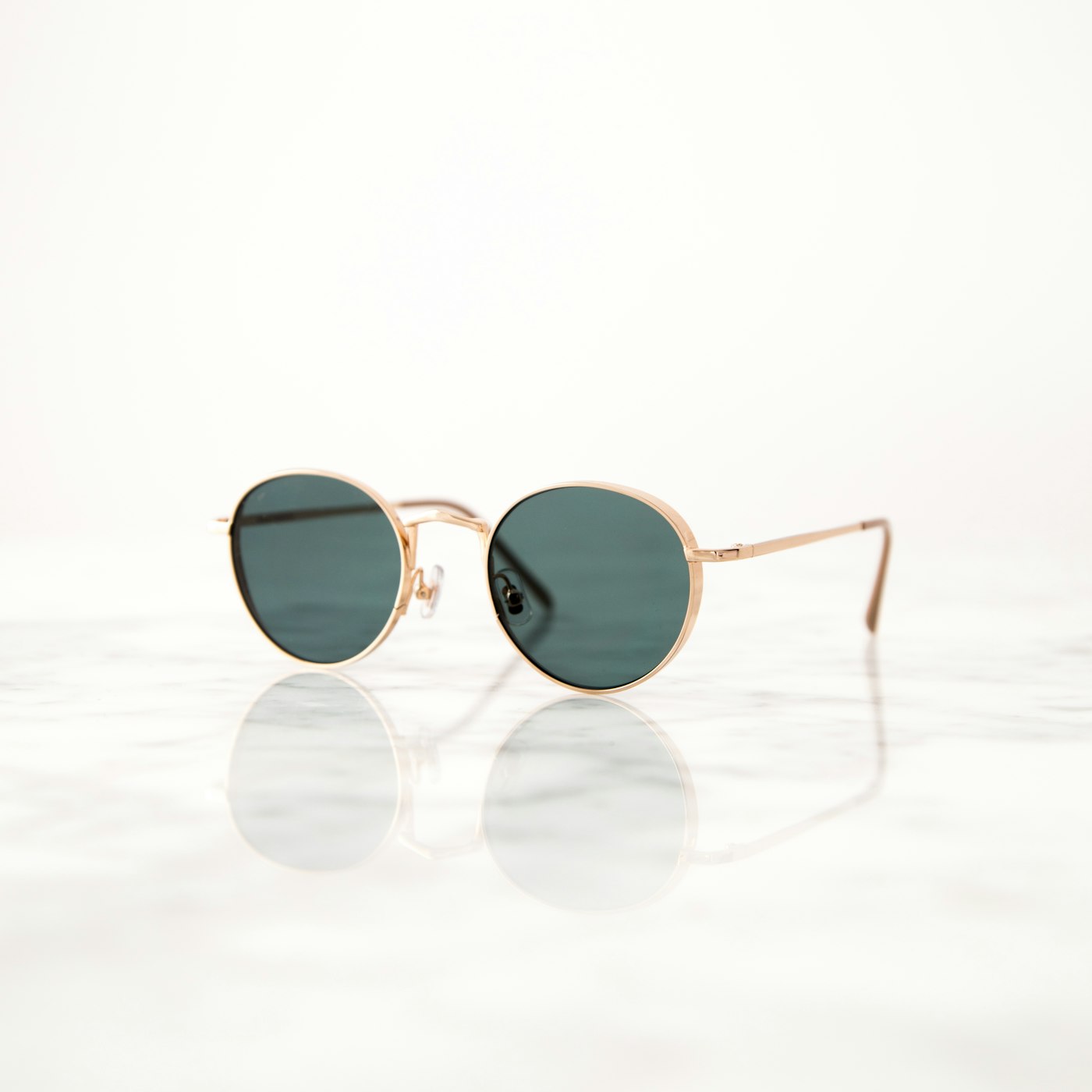
Buying sunglasses online is a strange kind of gamble. You're choosing a shape that sits directly on the most-photographed part of your body, based on nothing but a product photo of someone else's face. Face shape is the single biggest variable that determines whether a pair of sunglasses looks intentional or accidental on you, and it has nothing to do with price, brand, or trend.
The One Mistake Everyone Makes
Most people buy sunglasses based on what looked good on an influencer, a friend, or a mannequin in a store window. The problem is that frame shapes work by contrast: they succeed when they introduce something your face doesn't already have. A round frame on a round face doubles down on roundness instead of balancing it. A boxy, angular frame on an already angular jaw just adds more angles. The goal of face-shape matching isn't to find a "flattering" shape in some abstract sense — it's to find the shape that introduces the contrast your specific face is missing.
How to Find Your Face Shape
You don't need calipers or a stylist for this. Pull your hair back, look straight into a mirror in good light, and answer three questions:
- Is your forehead wider than your jaw, the same width, or narrower?
- Are your cheekbones the widest part of your face?
- Is your face noticeably longer than it is wide?
Your answers will point you toward one of five common shapes: oval, round, square, heart, or oblong. Most people are a close blend of two, which is completely normal — use the closest match as your starting point.
Oval Faces: Balanced Proportions, Most Frames Work
If your forehead is slightly wider than your jaw and your face is gently curved with no sharp angles, you likely have an oval face shape — considered the most versatile by eyewear stylists. Almost every silhouette works here, from oversized square frames to soft cat-eye shapes. The one thing to avoid is a frame so large it overwhelms your features; beyond that, this is the shape that gets to experiment freely.
Round Faces: Add the Angles You're Missing
Round faces have soft, curved lines with cheeks as the widest point and roughly equal width and length. The fix here is definition: angular frames like squares, rectangles, or geometric aviators introduce structure that a round face naturally lacks. Steer clear of small, perfectly round frames, which mirror your face shape instead of contrasting it, and can make round features look even softer.
Square Faces: Soften the Strong Jaw
A square face has a strong, angular jawline and forehead of roughly equal width, with minimal curve at the jaw. Round or oval frames are the classic fix, softening the hard lines of the jaw and forehead. Cat-eye frames are also excellent here, since the upward sweep draws attention toward the eyes and away from the angularity below. Avoid frames with hard, boxy corners that echo your jawline.
Heart-Shaped Faces: Balance a Wider Brow
Heart-shaped faces are widest at the forehead and cheekbones, narrowing to a pointed or delicate chin. The goal is to visually widen the lower half of the face to balance the brow. Aviators work exceptionally well here because the wider bottom edge adds width exactly where a heart-shaped face needs it. Round frames with a bottom-heavy silhouette are a strong second choice.
Oblong Faces: Interrupt the Length
An oblong face is longer than it is wide, with a fairly straight cheek line and sometimes a longer chin. The strategy here is to visually shorten the face by adding width. Oversized frames and frames with decorative or contrasting temples work well, as does anything that draws the eye horizontally rather than vertically. Avoid narrow, small frames, which tend to emphasize length rather than interrupt it.
Skip the Guesswork With Virtual Try-On
Here's the honest truth about face-shape guides, including this one: they're a starting point, not a guarantee. Lighting, hairstyle, and personal proportion all shift the equation slightly, and the only way to know for certain is to see the actual frame on your actual face.
That's exactly what TopFoxx's free AI virtual try-on is built for. Upload a photo, and our AI renders any frame directly onto your face in about twenty seconds, so you can compare an aviator against a cat-eye against an oversized round frame in real time, without a single return box. No account, no download, no guessing.
See it on your actual face, not a guideline.
Try on frames matched to your face shape instantly with free AI virtual try-on.